How to write an NDA (with a free template)
You're about to show your business plan to a potential partner, or let a freelancer see your client list. Before you do, you want them to agree to keep it to themselves.
That's what a non-disclosure agreement is for. For most of these situations a short, one-way NDA is enough, and you can fill in ours in a few minutes.
Use this templateWhat a one-way NDA covers
- Who's sharing (the disclosing party) and who's receiving (the receiving party).
- Why you're sharing it: the purpose, in one line. The other side can only use your information for that.
- What counts as confidential, and what doesn't, such as things that are already public.
- How long it lasts, and which state's or country's law applies.
If both sides will be sharing confidential information, you need a mutual NDA instead. Ask a lawyer to adapt the template.
Filling it in
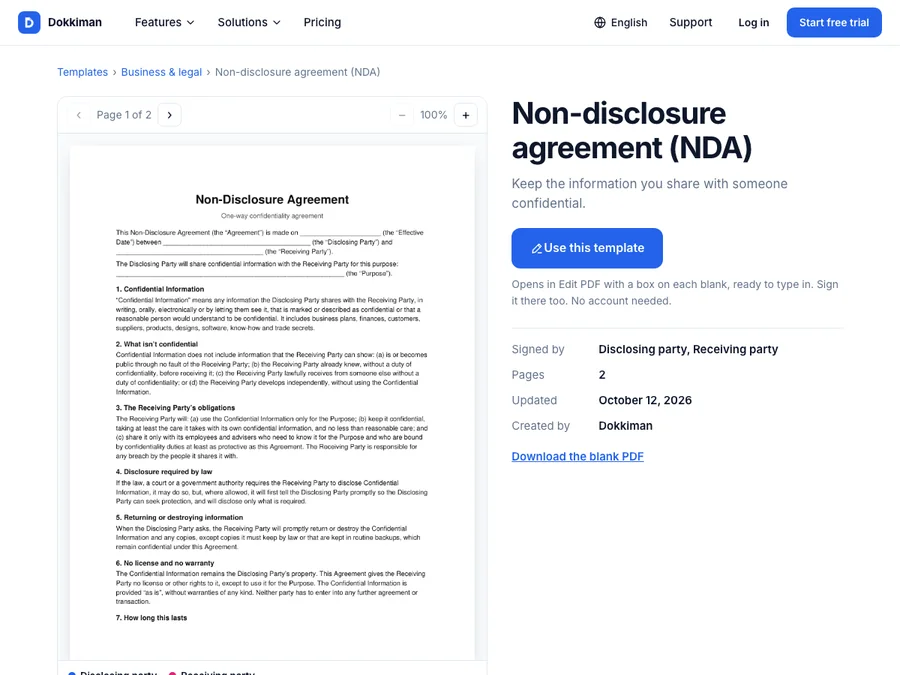
- Open the NDA template on Dokkiman and click Use this template.
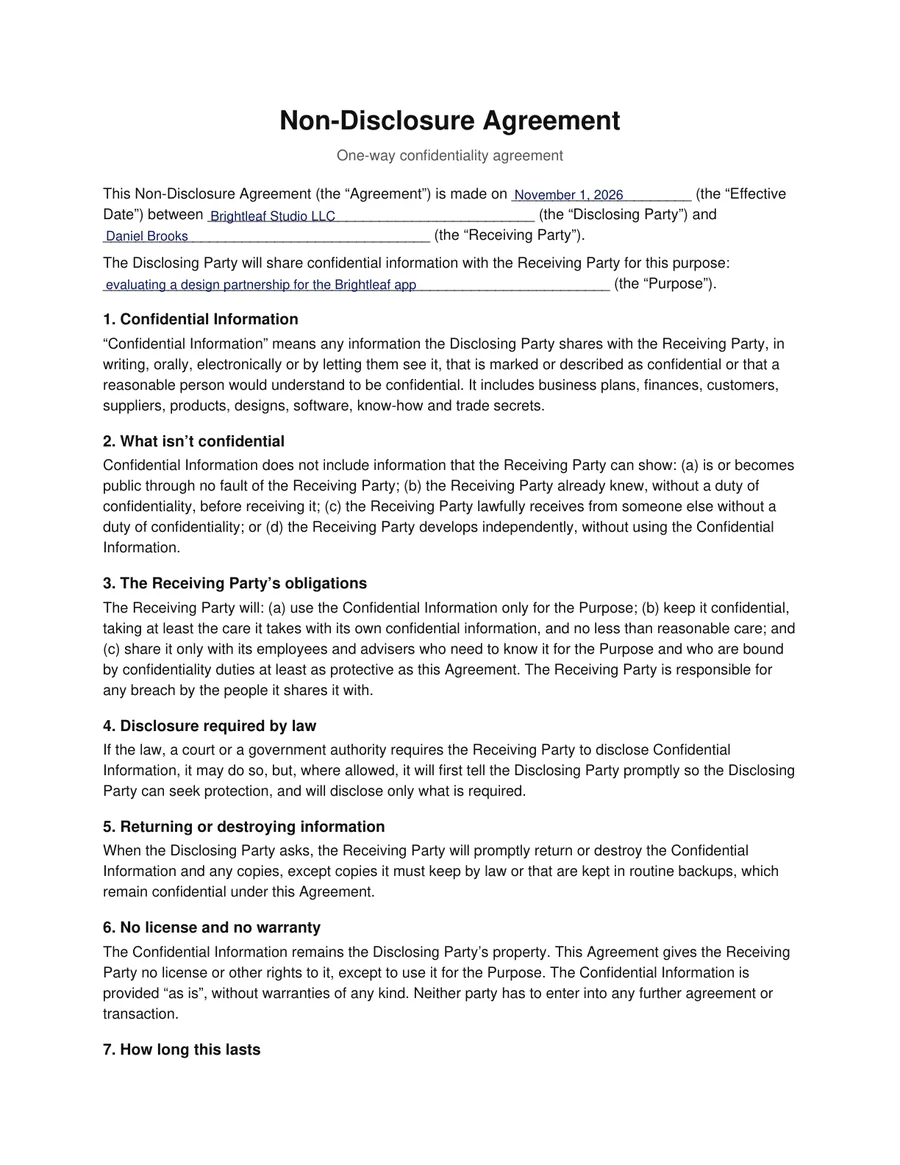
- Fill in the date, both names, the purpose, how many years it lasts, and the law that applies.
- Download it to sign on paper, or send it for e-signature so you both sign online and get the signed copy with a certificate.
Before you send it
Write the purpose narrowly. "Evaluating a design partnership" protects you better than "business discussions." And keep a note of what you actually share, so it's clear later what the NDA covered.
This template is a starting point, not legal advice. For anything high-stakes, have a lawyer look at it.
Common questions
- Is the template free?
- Yes. You can fill it in and download it without an account.
- Is an NDA signed online valid?
- In most places, yes. In the US, the ESIGN Act and UETA give e-signatures the same effect as ink.
- One-way or mutual?
- One-way if only you are sharing. Mutual if both sides are.