How to fill out Form W-8BEN (2026 guide for freelancers)
You've landed a client in the US, and before the first payment their finance team sends over a W-8BEN. If you don't send it back, they're supposed to hold back 30% of every payment for US tax.
The form is one page, and as a freelancer you'll probably fill in about half of it. This guide goes through it line by line.
Fill out this formWho it's for
The W-8BEN is for individuals who aren't US citizens or US tax residents and get paid by someone in the US. Think freelancers, contractors, creators paid by a US platform, or anyone holding US shares through a broker.
Running a company? Then you want the W-8BEN-E. And if you are a US citizen or resident, it's the W-9.
Line by line
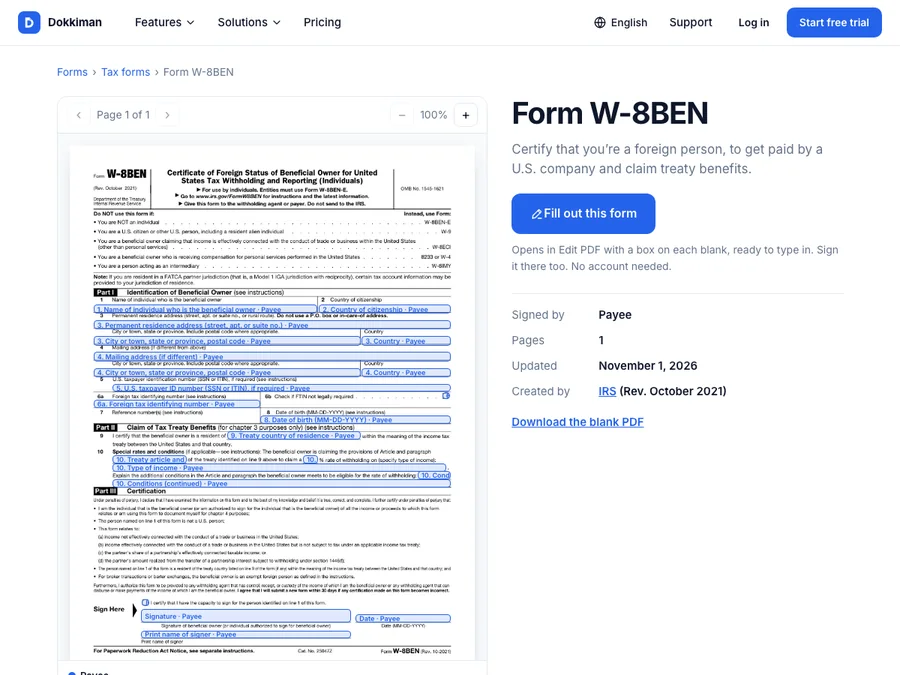
- Open the W-8BEN on Dokkiman and click Fill out this form. Each blank gets its own box you can type into, and you don't need an account.
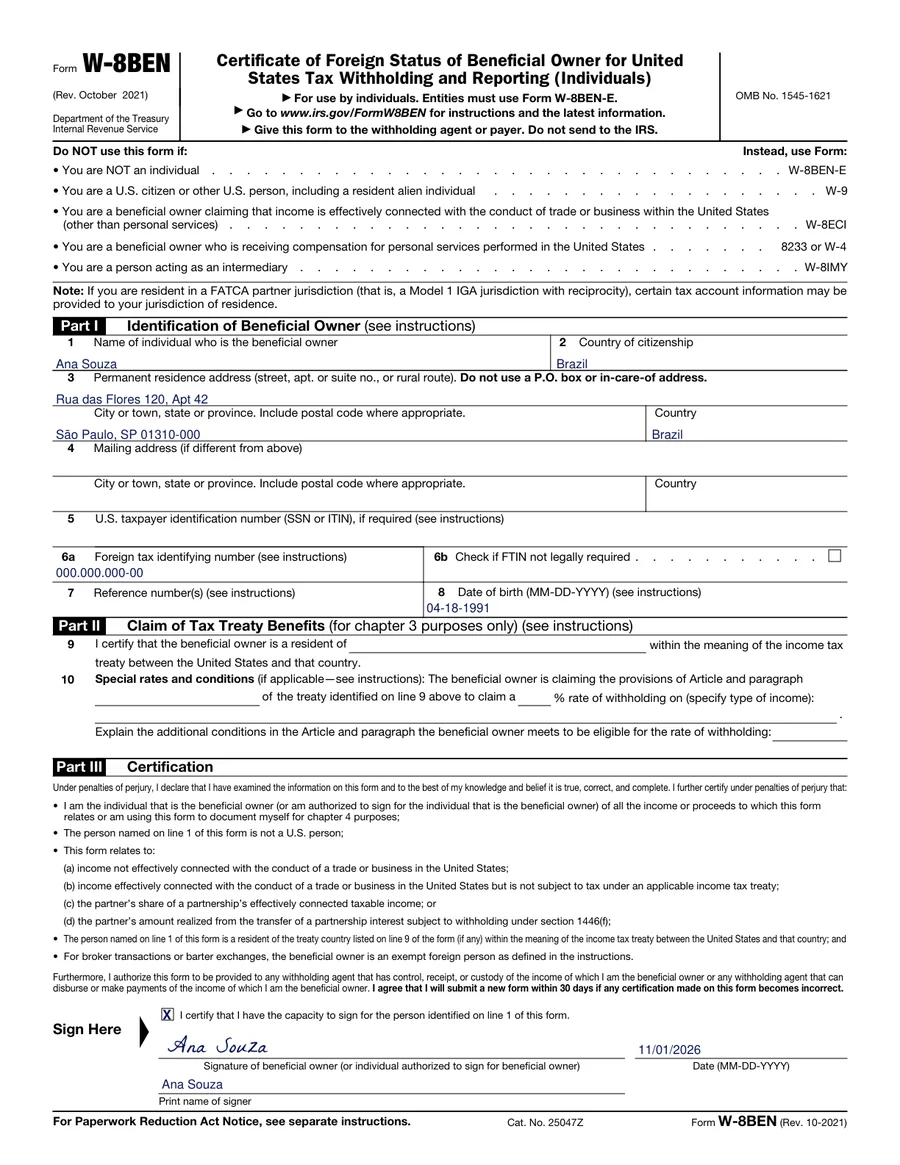
- Line 1 is your full legal name, the way it's written on your passport. Line 2 is your country of citizenship.
- Line 3 is where you actually live: street, city, postal code and country. A P.O. box won't do. Only fill in line 4 if your mail goes somewhere else.
- Leave line 5 empty unless you have a US Social Security number or ITIN and the instructions say you need it. Most freelancers have neither.
- Line 6a asks for the tax number your own country gave you, like a CPF in Brazil or a PAN in India. If your country doesn't issue one, tick 6b instead.
- Line 7 is only for a reference number your client gave you. Line 8 is your date of birth, written month-day-year (04-18-1991).
- Most people skip Part II. More on that below.
- At the bottom, tick the box, sign, add the date and print your name. Download the PDF and email it to whoever asked for it.
Do you need Part II?
Part II is for claiming a lower withholding rate under a tax treaty between your country and the US. It mostly matters for dividends, interest and royalties.
If you're paid for work you do from home, outside the US, that income generally isn't US-source, so there's usually nothing to withhold in the first place. Your client may still want the form on file. If you do have income a treaty could cover, the IRS treaty tables list the articles and rates, and an accountant can tell you which one applies to you.
After you send it
The form goes to your client or platform. It never goes to the IRS. Plenty of companies accept an e-signed copy, but some insist on ink, so ask if you're not sure.
It's good until December 31 of the third year after you sign it: sign in 2026 and it lasts through 2029. If you move, or anything else on it changes before then, send a new one within 30 days.
Common questions
- Do I mail it to the IRS?
- No. Send it to the company that pays you. They keep it on file.
- I don't have an SSN or ITIN. Is that a problem?
- Usually not. Leave line 5 blank and put your home country's tax number on line 6a.
- W-8BEN or W-8BEN-E?
- W-8BEN if you're a person. W-8BEN-E if you're a company.
- Is an electronic signature OK?
- Most payers accept one. If yours wants ink, fill it in online, then print it and sign it.